GOVERNANCE / IRELAND
The board seat that quietly got bigger
I'm at IoD Ireland's summer networking event tomorrow evening, so this felt like the week to write about where NED pay and NED risk actually stand. Three numbers, front and centre.
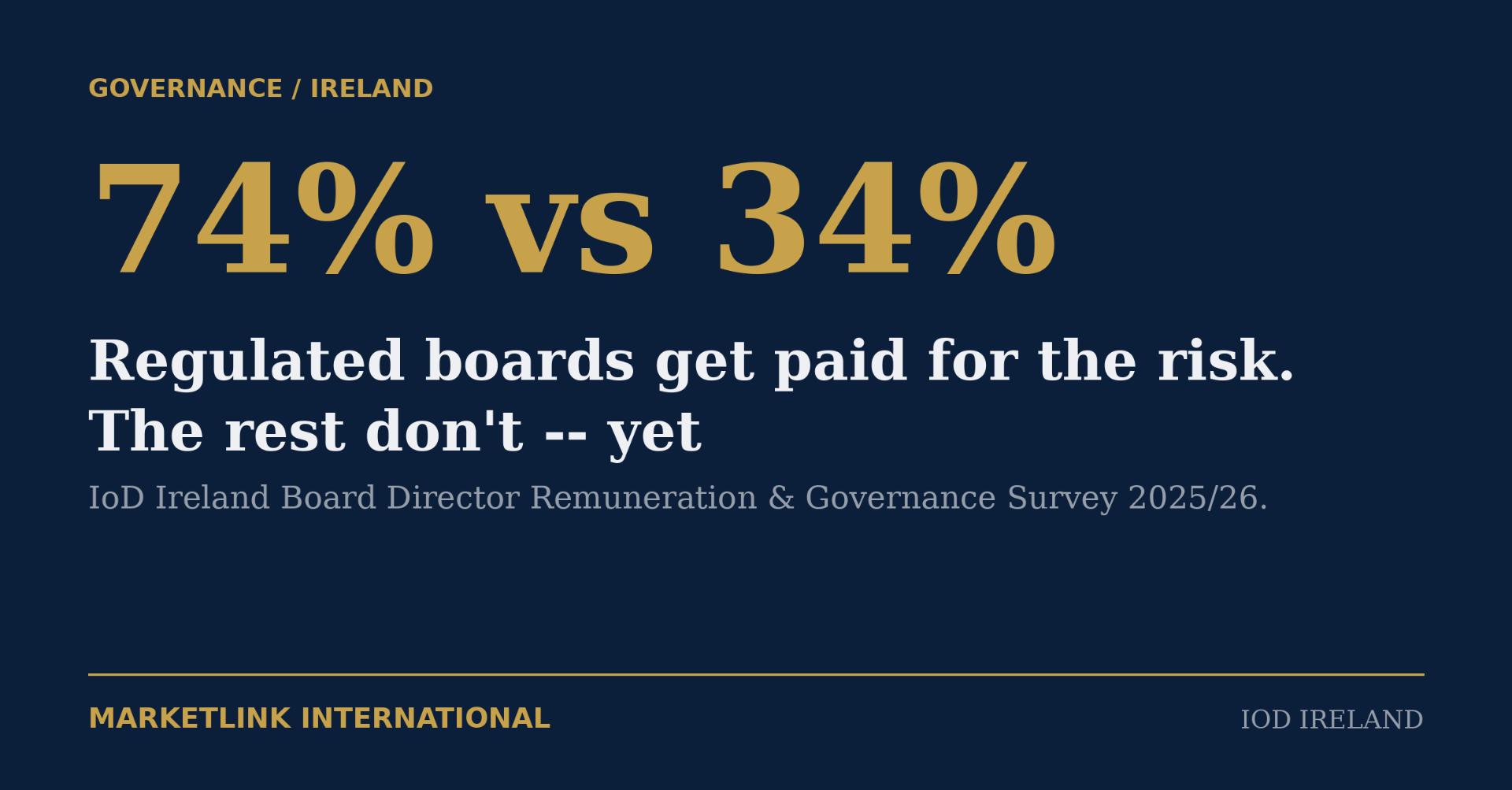
A director on a Central Bank-regulated board in Ireland is more than twice as likely to sit in the mid-to-upper pay tiers as a director doing broadly comparable work at a plc or a multinational. 74% versus 34%.
The regulated premium
That's from IoD Ireland's Board Director Remuneration and Governance Survey 2025/26, out now. It's the only independent Irish research of its kind: over 230 directors, 385 paid directorships, spanning private companies and plcs. 74% of directors in regulated financial services, and 73% of the chairs, sit in the mid-to-upper pay tiers. Across everyone else, plcs, multinationals, large private firms and SMEs, only 34% do.
The pattern is bigger than Ireland
It's broader than Ireland, and broader than pay. Korn Ferry's 2026 report on NED time and pay across the UK and Ireland, published in February and drawn from more than 200 NEDs on over 500 boards, found 80% saying the time commitment of the role has grown over the past five years, and 95% saying fees don't reflect the time and accountability the role now carries. That's near-unanimous. Directors are telling their own recruiters the fee has fallen behind the job.
And the accountability side keeps widening. Allianz Commercial's latest D&O Insurance Insights report, published in December 2025, finds cyber liability risk for directors rising sharply in recent years, with higher expectations for board-level oversight and more litigation and regulatory action following breaches. AI is the newest entrant on that list. This is the shape of the job changing everywhere at once, not an Irish or single-sector story.
The premium is leaking into ordinary boards
On paper the IoD gap makes sense. Central Bank regulation loads individual accountability onto financial-services directors, so the seat carries more personal risk and the fee reflects it. Fair enough. The quieter question the three reports raise together is whether that logic is now leaking into every other boardroom while the pay stays put.
Look at what's arriving on ordinary boards:
- AI oversight, and Ireland's incoming AI rules
- DORA
- Cyber and supply-chain resilience
- Named responsibility for systems the board can't fully see
The personal exposure that justified the regulated-sector premium is now landing on boards that still pay on the old, lighter scale, the one set when the job was quarterly oversight of a stable business.
70% of directors in the IoD survey say their pay reflects their role and their time. That's a comfortable number, right up until you notice it measures a job that has just been quietly enlarged. A seat priced for reviewing the numbers is not the same seat once it carries accountability for an AI system nobody in the room fully understands, or a cyber claim that lands at board level rather than staying with IT.
Everyone fixes on the 74%: regulated-sector directors who mostly earn in the mid-to-upper pay tiers. The number that matters is the 34%, the non-regulated boards where only a third do, now taking on AI, cyber and DORA risk at the old fee.
Two-thirds of non-regulated Irish boards are paying for a role that has turned into a bigger one without anyone repricing it, and almost every NED surveyed across the UK and Ireland agrees the fee hasn't caught up.
Why chairs feel this before the survey does
Good non-executives price risk for a living. When the responsibility on a seat rises and the fee doesn't, the strong candidates do the maths and say no. You're then recruiting from the pool that hasn't done the maths, which is precisely the wrong pool for a board taking on more liability.
So the practical read for a nominations discussion, and a fair question for tomorrow evening: if your board is quietly absorbing regulated-level responsibilities without regulated-level scrutiny in its own pay and composition, that mismatch won't stay hidden. It shows up first in who is willing to join, and then in who you wish had.