Boards have to own AI. Trust starts there.
Written up from my notes at CeADAR's Trust in the Loop, Croke Park, 20 October 2026.
At Croke Park on Tuesday, the executives building AI into Irish companies kept coming back to one word: trust.
CeADAR Ireland's Trust in the Loop event put the Department of Enterprise, Enterprise Ireland, IDA Ireland, the AI Office of Ireland, Google, OpenAI and about 20 organisations in all on stage over the day.
Leadership has to own AI
Leo McAdams of Enterprise Ireland made the point on the opening panel. Leadership and boards have to be responsible for AI and involved in it, and it can't be handed to someone further down the organisation.
He wanted AI built into the business strategy. In his words: "AI is not standalone."
His closing point was about trust. A lot of companies don't have a playbook for AI, and if more trust gets into the system, he said, adoption should go faster.
How 4 Irish organisations gate their AI
Irish Lights started with a digital maturity assessment and an AI policy, and staff couldn't use AI tools until they'd done the training. EirGrid gates access the same way. It's testing AI on its slow grid-connection process in a sandbox, away from live operations.
Envaira calls its version a "human envelope": nothing is published until one of its environment, health and safety experts has checked it. Armac Systems gives users a "big red button", marks AI-generated data apart from factual data, and lets each user set their own risk tolerance.
Each of those is a decision about how far the organisation trusts a machine, and I'd argue it belongs with the board.
The IoD Diploma drilled one rule into me: a board can delegate the work but never the accountability. AI is the newest test of that.
An AI policy needs an AI strategy
The regulation panel was blunter about the burden. Panellists said Europe's rules are already hard to meet for small firms, and that big Irish businesses are well ahead of small ones on AI.
Small firms also have the least room for an AI project that goes wrong. Settling the trust question early, while it's cheap, matters most for them.
One panellist put the gap simply: an AI policy sets what staff may do with AI, while a strategy sets what they should be doing with it.
The same panellist's answer was AI champions: 1 or 2 people given the time to work the strategy out. Emma McGuire of OpenAI said the organisations that do this well have leadership advocacy, and give people time away from the day job to think.
The writer who gave the opening talk on trust asked: "If I cannot trust the leaders, then how can I trust their machines?"
The AI Act will catch a lot of HR tools
On the regulation panel, one panellist estimated that around 90% of the companies using high-risk AI are in human resources (HR).
Annex III of the EU's AI Act lists AI used "to analyse and filter job applications, and to evaluate candidates" as high-risk. It also covers AI used to monitor and evaluate staff performance.
Under Article 25, a company that changes an AI system's intended purpose so it becomes high-risk is treated as its provider. Use a general-purpose model to screen CVs and you may be that company.
The same panellist's practical advice: check your AI vendor contracts for intellectual property (IP) warranties on training data and outputs.
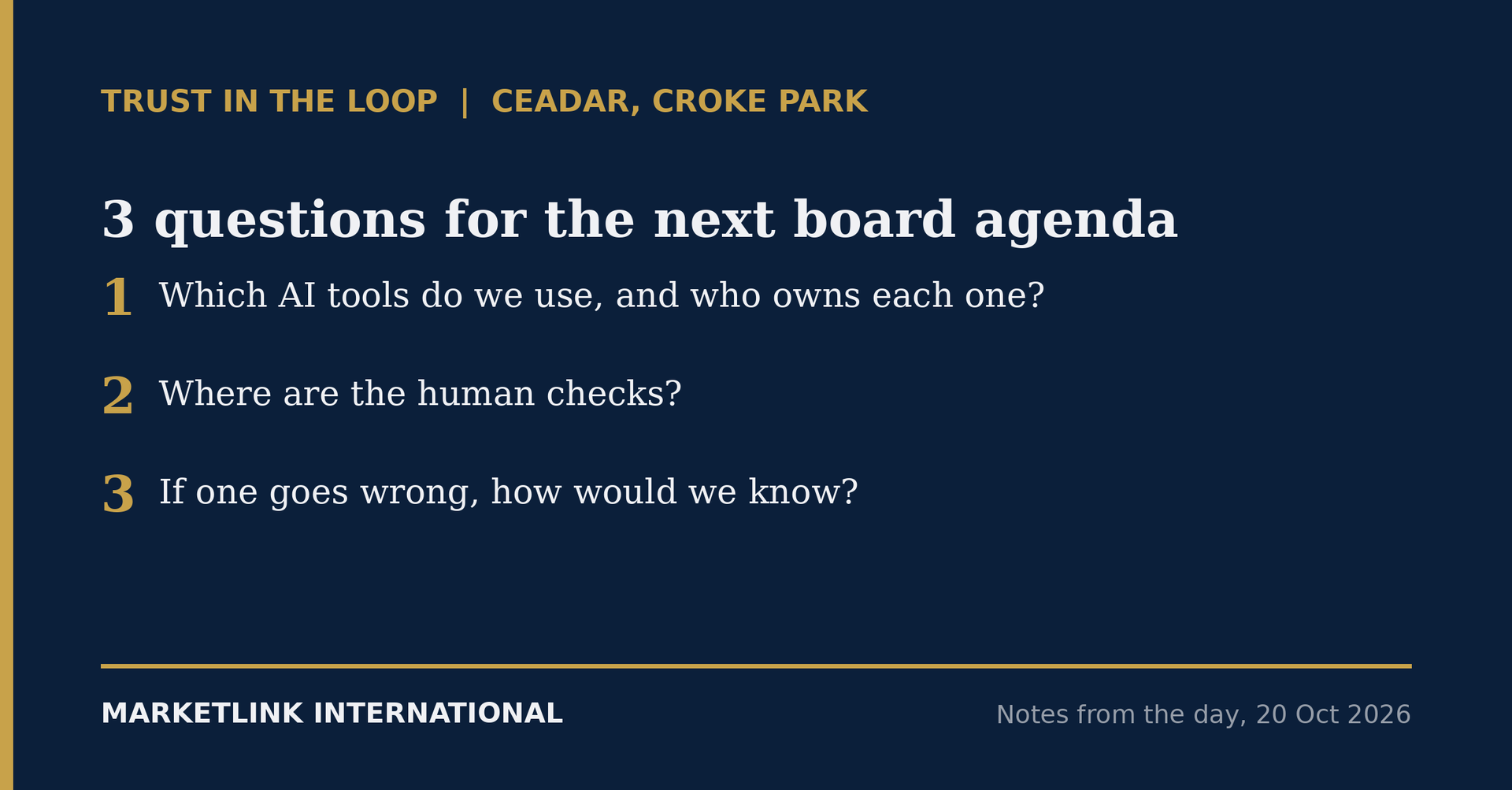
3 questions for the next board agenda
1. Which AI tools are we using, and who's responsible for each one?
2. Where are the human checks, and were they designed in or bolted on?
3. If one goes wrong, how would we know?
And if any of those tools screen CVs or rate staff, ask whether the law treats you as the provider, which carries most of the duties, or only as the deployer that uses it.
If this was useful, forward it to one other board member. You can get The Boardroom Brief by email on Substack.
The event, with the full speaker list: Trust in the Loop: Responsible AI Basecamp, CeADAR.
If this question is on your board's agenda, read how I work with boards, or get in touch.