
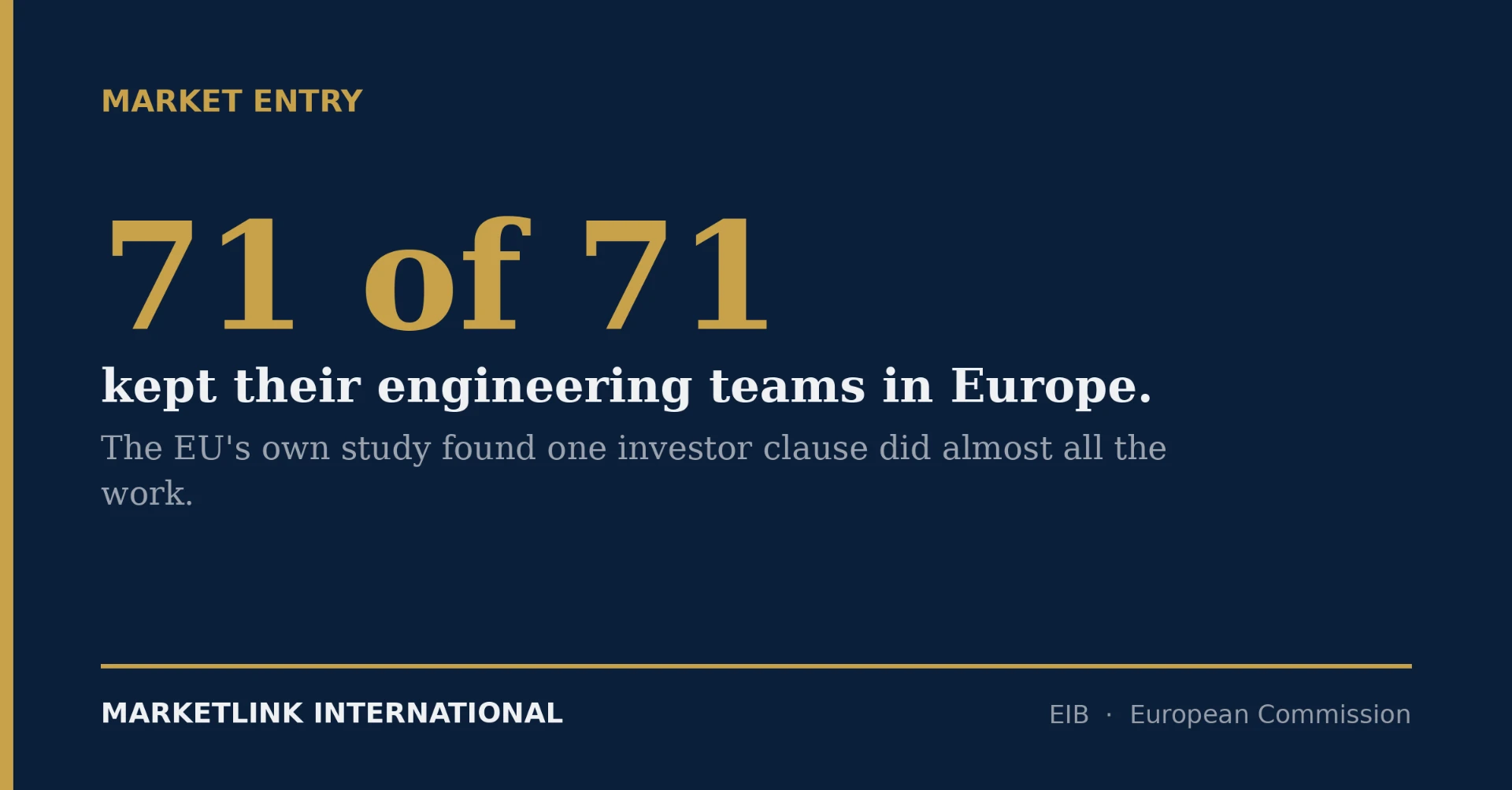
The EU studied 71 companies that "fled" to America. All 71 kept their engineers at home.
The European Investment Bank and the European Commission tracked 440 European startups and scaleups founded since 2010. They interviewed 91, and built core findings from 71.
Every single one of the 71 relocated only partially. None closed its European operation. None moved its engineers.
What moved was the legal shell. Most often a flip into a Delaware C-corp, keeping the product team in Berlin or Dublin and putting the holding company where the next investor wanted it.
The report names the actual trigger plainly: an investor's requirement, explicit or implicit, that the company be US-incorporated, preferably in Delaware. It calls this "the most significant immediate trigger for relocation," ahead of ambition, talent or tax rates in the abstract.
One line in a term sheet, repeated often enough across enough rounds, and you get a pattern that looks like an exodus from the outside.
This is the part that should land on a board agenda. Germany, France and the Netherlands tax unrealised gains on IP when a company moves its legal entity or IP ownership abroad.
Wait until the US round is signed to think about domicile, and you can owe tax on value you haven't banked yet, on IP that hasn't been sold. The founders interviewed for the report flagged this directly: the penalty falls hardest on the companies that waited longest to decide.
I spent 11 years in Silicon Valley doing exactly this kind of work for European and Asian companies, including a long run with Enterprise Ireland and then heading FirstCapital's US desk. I watched this pattern up close, long before this report existed.
The decision point was never "should we go to the US." It was always "when do we fix the entity structure." The companies that treated that as a legal afterthought paid for it later: in tax, in dilution, in a board scramble mid-round.
The EU's own fix, so far, is narrower than the problem. In September the Commission proposed a European Innovation Act: a common framework for valuing IP, plus a digital marketplace connecting IP buyers and sellers.
The Commission's own estimate: €10.2bn a year freed up in additional financing. Useful, and it closes a real gap the January report also flagged, where founders asked for exactly this kind of valuation framework.
It does not touch the exit tax, which stays a national matter. Nor does it build the pan-European entity the report itself called for, "an EU Delaware," that would let a company reincorporate without the current one-way trip.
The same Innovation Act has a second plank worth a board's attention even if IP valuation isn't your issue: a common EU procedure for R&D procurement. The Commission estimates it could save public buyers €1bn a year and add almost €26bn a year to company profits.
A companion proposal would create EU-wide regulatory sandboxes: a reference framework for testing new products under supervision that today exists in some member states and not others. Both are still proposals, working through the legislative process.
For a board sitting on a cross-border growth plan, the live question is whether your board decides domicile and IP ownership on its own timeline, with its own tax advice, or leaves it to the next term sheet under a deal deadline.
On this data, most boards will eventually face a US investor's incorporation preference. The only open variable is who sets the timing, and how much a delay costs.
If your company is planning a move between Europe and the US, read how I work on market entry, or get in touch.