
Writing
54 of 190: what Ireland's FDI numbers tell a board planning a European entry
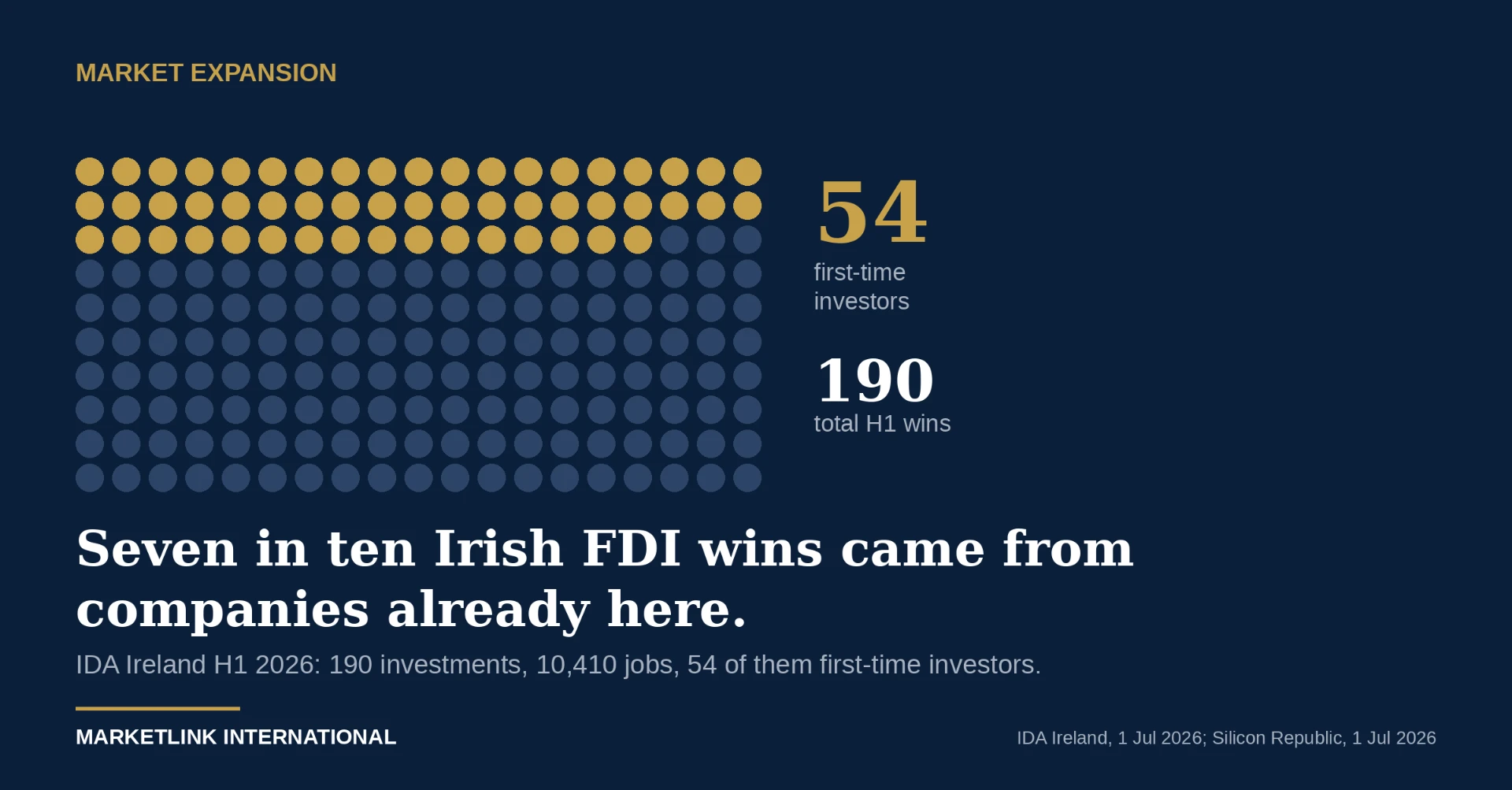
IDA Ireland won 190 investments in the first half of this year. 54 of them came from companies that had never invested in Ireland before.
The headline is 190 investments carrying 10,410 job commitments, up from 179 investments in the same period last year. A strong result in a hard market, and IDA is entitled to the credit.
The composition is where it gets interesting. Of the 190, IDA classes 39 as expansions by companies already operating here. That sounds like the depth number, and it isn't. Expansion is a narrow label. The real measure is the other one: if 54 investors were here for the first time, the other 136 were not. Roughly seven in ten of the wins came from companies already inside the country. 98 of the 190 were regional, 52% of the total.
The full-year figures say the same thing more plainly. IDA supported 323 investments in 2025, of which 78 were new names. Three in four wins from companies already here, over a full twelve months. At 190 by the end of June, 2026 is running ahead of that pace.
Why depth is the better signal
A company that puts a second or third investment into a location has tested the talent market, the planning system, the energy connection and the tax position with real money, and then come back. That is a harder signal to fake than a first announcement. If I were assessing whether a location actually works, it is the one I would weight.
Look at where the deepening investments went. OpenText committed €105m across Cork and Galway for 400 jobs in agentic AI and sovereign cloud. Qualcomm put €125m into Cork as an AI pillar of its global chipmaking business. Anthropic is adding 200 jobs in Dublin. Novo Nordisk is spending €432m in Athlone.
Every one of those is a company that was already here.
The 2025 annual report puts a figure on what that deepening looks like across the whole client base. Clients committed a record €2.5bn to research and development across 80 projects, €1bn of capital across 31 sustainability projects, and €307m across 66 talent development projects that will upskill more than 33,000 people. That is the money a company commits once it has decided the place works.
Landing in a market is the easy part. The value shows up in the second investment, and most boards budget only for the first.
What a foreign board should take from it
I spent 11 years in Silicon Valley, first with Enterprise Ireland and later running US market entry. The pattern I saw again and again was a board approving an entry and treating the approval as the final decision. I'd call it the option fee.
If you are looking at Ireland, or at any European entry, these numbers tell you who you are really competing with. You are up against companies already there, on their third project, with a hiring reputation, a working relationship with the agency and a track record the local management can point to.
Three things change in the board approval paper your executive brings you.
- The talent pool. In Dublin you are recruiting against firms whose Irish operation is a decade old. Budget for that, or site where the competition is thinner. Cork, Galway and Athlone are carrying serious investment for a reason.
- The time horizon. Ask what investment two looks like and what would trigger it, before you approve investment one. If nobody can answer, you are funding a beachhead with no plan to reinforce it.
- The reason. Silicon Republic reported that Trading 212 and Block both picked Ireland as a European launchpad and regional headquarters base this year. I read both as jurisdiction decisions, about market access and regulation, more than cost decisions. An entry paper built on cost will be outbid. One built on access can still be defended in three years.
The question I'd put to an executive proposing a market entry: do we ever see the second investment modelled, or only the first?