The AI tools staff pick for themselves show what the approved ones lack, and expose the company to data leaks
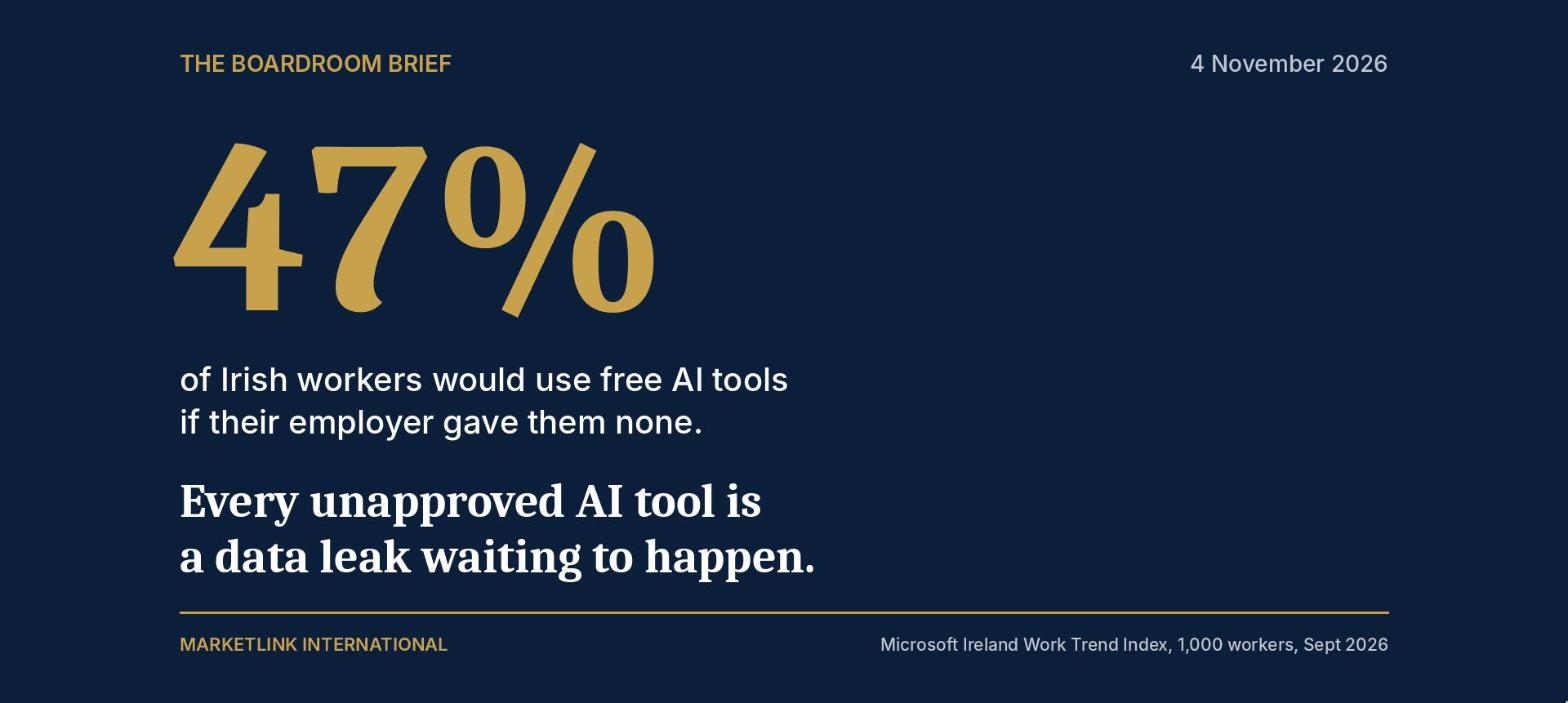
Almost half of Irish workers, 47%, say they would use free, public artificial intelligence (AI) tools if their employer did not give them a suitable one. Only 51% say their organisation has clear rules on what data can go into AI tools. Both figures come from Microsoft's Ireland Work Trend Index, a survey of 1,000 workers published on 10 September 2026.
Boards tend to read that as a data risk, and it is a very big one. I think it is also the clearest evidence a board will get of what its people need and are not being given.
The surveys tell the same story. Accenture ran a similar survey on a smaller Irish sample of 194 employees: 34% use AI tools their employer provided and 30% found their own. In the United Kingdom (UK), Deloitte asked 25,000 workers in May and June 2026. Of those using generative AI (the kind that writes, summarises and answers questions), 31% do so without their employer knowing, and about half have had no formal training.
I have heard the same thing at a session for non-executive directors in September and at an Institute of Directors (IoD) Ireland webinar on AI governance in October. Staff are either ahead of the policy, or there is no policy to be ahead of.
Company data and contracts
When an employee pastes a contract or a customer list into a free chatbot, there may be no business contract with that AI supplier and no data protection agreement behind it. Whoever owns data protection risk for the board owns this too.
I'd argue there is a cost as well. If an organisation pays for an approved tool and only a minority of staff use it, the money spent on it is wasted. With 31% of generative AI users keeping it from their employer, I think much of the gain from their own tools goes unseen by management.
What unapproved tools tell you
Just 40% of Irish workers in the Microsoft survey say they have had enough AI training or guidance. Fewer than half, 44%, say their employer gives them the AI tools and resources they need. PwC Ireland found the same gap later in September: 45% of Irish workers say they have the learning resources they need, down from 57% a year earlier. Staff who pick their own tools are showing management where the approved tools fall short.
Some unapproved use is simply a preference for one product over the one the organisation chose. The IoD Ireland Shadow AI Audit below, which Ger Perdisatt of Acuity AI helped build, separates preference from need.
In the Microsoft survey, 13% say they would consider changing employer for better AI tools. That makes this a question about retention as well as a question about risk.
The Shadow AI Audit
Shadow AI is the term for AI tools staff use without the organisation's approval. The most practical answer I have seen is the Shadow AI Audit in the IoD Ireland AI Governance Toolkit. Management surveys department heads and a sample of staff, then lists every AI tool in use, including AI features switched on inside software the organisation already pays for.
Each tool then gets one of four decisions (block, make official, adopt or monitor), with a named owner and a timeline. Non-executive directors can see what is in use and how management is responding.
I'd treat the audit as internal market research as much as a risk exercise. Each unapproved tool points to a task that someone found slow enough to fix on their own.
IoD Ireland ran a members' webinar on the toolkit on 8 October, given by Ger Perdisatt, founder and chief executive of Acuity AI. His advice was to run the audit through human resources, operations or the business units, with the information technology team in support. Treat it, he said, as a way of understanding why people use what they use. Decisions about switching things off come after that. Every organisation he had worked with found more AI in use than it expected. The UK's National Cyber Security Centre made a similar point in September: the aim is to minimise the risk, since it cannot be removed entirely.
The AI literacy duty since July
Since 27 July 2026, Article 4 of the European Union's AI Act asks organisations that use AI systems to take measures to support their staff's AI literacy. That means a working knowledge of what the tools do and where they go wrong. The old wording about ensuring a sufficient level has gone, and the law now says no organisation has to guarantee any individual's level.
It is a lower bar, but the duty to act is still there. A board should be able to say what those measures are and where they are recorded. The better answer is evidence of how staff actually use AI. A training record on its own says little.
Four questions for the next board meeting
- Can management list every AI tool in use today, including AI features inside existing software?
- Which of those tools hold customer, staff or financial data, and do we have a business contract with each supplier?
- How many staff actually use the tools we pay for, and what are the rest using instead?
- What have we done to support staff AI literacy, and is it written down?
If management cannot answer the first question quickly, I'd start there.
I'd welcome your comments.
If this question is on your board's agenda, read how I work with boards, or get in touch.
Sources
- Microsoft Ireland Work Trend Index 2026, 10 September 2026 (1,000 workers in Ireland, surveyed by 3GEM)
- Accenture, Generating Impact: Ireland, 2026 (YouGov survey of 2,085 employees in the UK and Ireland, of whom 194 in Ireland, February to March 2026)
- Deloitte UK, GenAI Workforce Survey, 16 September 2026 (Ipsos survey of 25,000 UK workers, May to June 2026)
- PwC Ireland, Workforce Hopes and Fears 2026, 28 September 2026 (1,004 workers in Ireland, May to June 2026)
- National Cyber Security Centre (UK), The hidden risks of shadow AI, 7 September 2026
- IoD Ireland AI Governance Toolkit, Shadow AI Audit
- Regulation (EU) 2026/1744 of 8 July 2026, Article 1(5), replacing Article 4 of the AI Act (full text)
- Regulation (EU) 2026/1744, entry into force 27 July 2026 (EUR-Lex record)