
Small firms must label AI content too, and one shared log shows what needs a label
Written up from the Generative AI (Gen AI) Masterclass on Zoom on 27 October 2026, run by RDI Hub, the innovation centre in Killorglin, Co. Kerry, as part of its Smart Regions AI Navigator programme for small firms.
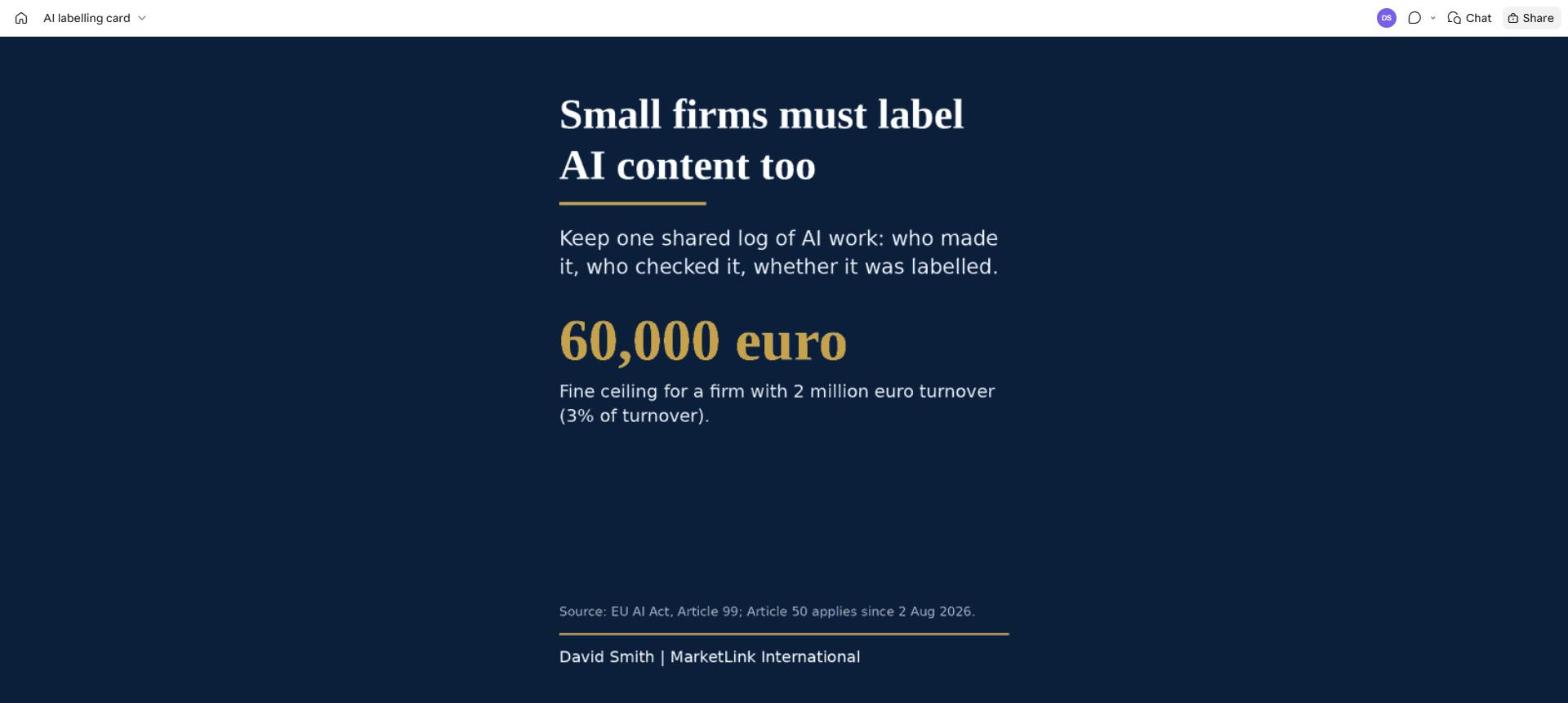
A small firm with turnover of 2 million euro can be fined up to 60,000 euro for breaking the EU's rules on labelling AI content, which is 3% of its turnover. At the Gen AI Masterclass, AI governance specialist Ciara O'Buachalla said no such fines have been issued yet.
The ceiling comes from Article 99 of the AI Act: 15 million euro or 3% of worldwide turnover. The lower figure applies to a small or medium-sized enterprise (SME), and the higher figure to a large company.
The labelling rules are in Article 50 of the Act and have applied since 2 August 2026, whatever the size of the firm. The EU's AI Omnibus regulation moved the rules on high-risk AI to 2 December 2027, while the labelling rules stayed at 2 August 2026.
Label what the public sees, log what staff make with AI, and leave spelling fixes alone
Maeve Lyons, programme manager at RDI Hub, opened with a three-way test: label realistic AI images, video and audio, chatbots, and AI text published to inform the public unless a person has reviewed it and takes editorial responsibility; log anything AI created that you use in your work; leave help with spelling, tone and spreadsheet formulas.
One shared log lets a firm show who checked each piece of AI work
Maeve Lyons suggested one shared log for the whole organisation: date, name and tool; what was produced and for which client or project; whether AI created it or refined someone's own draft; personal data used; who checked it and whether it was labelled.
Vinny O'Brien, an e-commerce strategist, said: if it is not written down, it did not happen.
Four questions show whether the board knows where its AI content goes
- Which of our customer-facing tools are chatbots, avatars or AI voices, and do they tell people they are AI from the first interaction?
- Where do we publish AI-made images, video or audio of real people, places or products, and who decides whether each one carries a label?
- Do we keep a log of AI-created work used for clients, showing who checked it and whether it was labelled?
- Have we passed our labelling rules on to the agencies that make content for us?
This piece is also published in full: Read on LinkedIn or Read on Substack.
If this question is on your board's agenda, read how I work with boards, or get in touch.